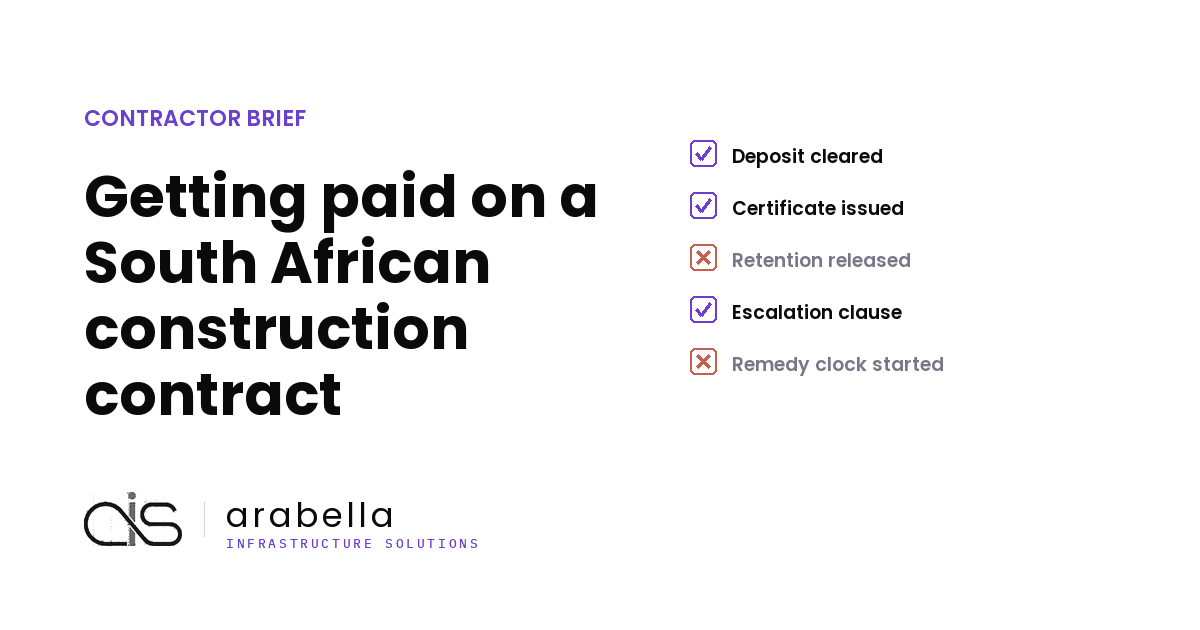
Getting paid on a South African construction contract is decided by five clauses you signed, not by how good the client is. The deposit, the payment certificate, the retention, the escalation provision and the remedy for non-payment each have a date attached, and the money arrives or does not on those dates. This is the piece that puts the five in one place, with the detail in the pieces beneath it.
Why does the contract matter more than the client?
Because every payment problem on a South African site is a clause problem first. A client who pays late has not opened a commercial conversation; they have triggered a provision with a clock on it. A contractor who knows which provision, and when the clock started, gets paid. A contractor who sends a fourth email does not.
The five clauses run in the order the money moves. What comes in before you start, what comes in as you build, what is held back, what moves with prices, and what you can do when the rest does not arrive.
1. The deposit
On private work, a deposit before the contractor starts is normal and reasonable. Materials are bought up front, and the deposit is what pays for them. What protects the contractor is that the deposit is in the account before anyone starts, not promised. What protects the client is the trigger for the balance: an event the client controls, sign-off rather than the contractor's invoice.
On public work there is usually no deposit at all. The money comes as certified progress payments, which is why the next three clauses matter more there than anywhere.
2. The payment certificate
Under the standard forms, JBCC, GCC, NEC and FIDIC, you are paid against a certificate. The contract's agent or engineer measures what has been built and certifies the value, and the client pays that certificate within the period the contract sets. A certificate that is not issued, or is issued and not paid, is the most common place the money stops.
The scale of the second problem is on the record. National Treasury's quarterly report counts R15,5 billion across 90 856 invoices unpaid for more than 30 days at the end of the third quarter of 2025/26. Some 98% of it sits with provincial departments rather than national ones. The remedies, interest, suspension and in serious cases termination, are in the forms, and most of them start running on the day the money did not arrive. What to do when a client will not pay a certificate goes through them clause by clause, and through the compliance documents that expire while you wait.
3. Retention
Retention is the percentage held back from every certificate against defects, and how long it can be held is set by your contract, not by any statute. Five percent is the market standard; nothing stops a contract asking for more. Under the JBCC Principal Building Agreement half is released at practical completion and the balance at the end of the defects period.
On a R3 million contract at 5% that is R150 000 held across the works, and R75 000 sitting out the defects period afterwards. At prime, R150 000 held for nine months costs R11 812 in interest on one job, and the larger cost is the working capital you cannot use to price the next one. How long retention can be held in South Africa has the arithmetic and the three moves when it is held past its date. It also covers the JBCC clause 14 choice between a retention and a guarantee, which almost nobody negotiates.
4. Escalation
A fixed-price contract is fixed for exactly one party. Diesel moved 28,8% year on year to July 2026, and steel carries a safeguard duty that moves on a gazetted timetable. Whether any of that reaches your price depends on three things: whether the contract has a contract price adjustment provision, what index it uses and what it excludes. Three questions decide it and you can answer them in ten minutes with the contract open.
Fuel escalation on a contract you priced in June works through the three, and the steel safeguard duty shows where a duty actually lands inside a fabricated rate. The lesson both pieces reach is the same: price the next contract differently, because the current one will not move.
5. When the client runs out of money
The failure that no clause fully protects against is the client whose budget is finished. A municipal contract that stops at 95% because the vote is spent is a real case. Johannesburg Water's Erand Tower and Pump Station in Midrand is suspended at roughly 95% complete while the Section 116(3) approval process under the MFMA runs to secure more funding. The costs that keep running while nothing happens, standing time, plant, the site establishment, are the contractor's until the contract says otherwise.
When a municipal contract runs out of money at 95% sets out what to read in your own contract before you read the Act. It also says what a stopped job tells you about pricing the next tender.
What to do on Monday
Open the contract for the job that is most behind on payment and find the five clauses. Write the five dates next to them. When the deposit cleared, when the last certificate was due, when practical completion was certified, what the escalation base date is, and what the remedy clause requires before you may suspend. Most of the answer is in that list. The rest is in the pieces above.
Arabella Infrastructure Solutions is a Johannesburg-based vetted contractor panel that fixes the first two of those clauses before a job starts. Award is on 85%, no contractor starts before it clears, and the final 15% follows the client's sign-off with the certificate the trade requires. It does not change your other contracts. It does mean the panel's work is paid the way this piece says work should be.