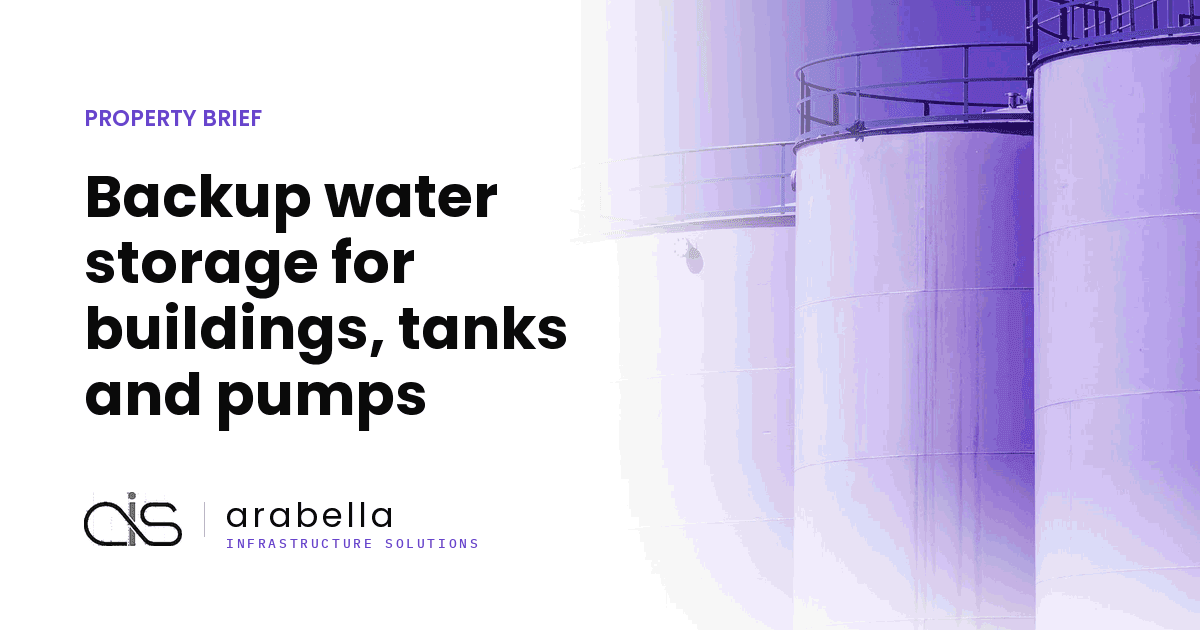
Backup water storage for buildings in South Africa needs two parts. A tank holds water for when the municipal supply stops, and a booster pump set delivers it at usable pressure. Where the supply is both intermittent and weak, the building needs both, and we recommend a registered plumber fits them.
That is the short answer for a block that has just spent two days without water. The longer one depends on how long your outages last, how many people the building serves and what the supply pressure is like on a normal day.
How often South African buildings lose water
GroundUp reported on 2 October that Durban and Johannesburg are the metros where long water interruptions are most common. It counts households whose water outages lasted two days or more in 2025: 44% of households in eThekwini and 40% in Johannesburg, against about 38% nationally.
Two days is the number to hold on to. It is also the outage the Johannesburg project below was designed to ride out.
The season ahead makes the question sharper. South Africa's ENSO Reference Group expects an exceptional El Niño, possibly the strongest on record, and forecasters expect it to peak between November 2026 and February 2027, Infrastructure News reported. El Niño's main danger for this country is drought and strained water resources. Dam levels are healthier after two good rainy seasons, but the scientists warn those buffers are no guarantee.
Do I need a tank, a pump, or both?
A building that loses water for days, and has weak pressure the rest of the time, needs both. Storage solves the outage, and pumps solve the pressure. When the supply is weak even on a good day, a tank on its own may not deliver water to the upper floors at usable pressure.
A recent Johannesburg project shows the full arrangement. The University of Johannesburg spent R11 million replacing the plumbing in eight student residence blocks, about 260 students, between September 2025 and July 2026, Plumbing Africa reported. Because of "low council pressure and intermittent supply of water", the design had to solve two problems at once, Plumbing Africa said. The article quotes Mark Setaro of Mekan Group on the project.
His answer had four parts:
- Storage. A 128 kl sectional storage tank holding about two days of water during municipal shutdowns.
- Pressure. A duty and standby booster pump set, sized after hydraulic calculations to a pumping head of 52m.
- Control. A pressure sensor on the 90mm ring main drives the pumps to hold 4 bar.
- Wear. The two pumps run on a lead and lag basis, so each gets equal running hours and neither sits idle.
Even the hot water tanks were oversized slightly to allow two days' storage. The main storage tank was sized for about two days of shutdown.
Sizing it for your building
Start with people, not with a tank catalogue. By our arithmetic, UJ's 128 kl over about two days works out at roughly 250 litres per resident per day. That includes all uses on the site, so treat it as a figure to compare against, not as a rule.
Then cut the demand before you buy the storage. UJ fitted shower heads that use about 6 litres a minute against roughly 10 for conventional ones, around 40% less water for every minute in the shower. Every litre you do not use is a litre you do not have to store.
Weight is the third question. A litre of water weighs a kilogram, so 128 kl is about 128 tonnes. Whether a tank sits on the roof, on a stand or on the ground is a structural engineer's decision before it is a plumber's.
Storage, pressure or source
A tank and pumps store and move municipal water. They do not make new water. If your outages run past the storage you can fit, the next question is an alternative source, and a borehole carries its own registration duties, set out in the borehole registration piece.
For a sectional title scheme, who signs off the spend matters as much as the specification. Who approves the quote in a sectional title scheme covers how that decision is taken.
Who should fit backup water storage?
We recommend a registered plumber designs the connection and fits it, and can certify the work. We have not found a single rule that makes this compulsory for every tank, so check your municipality's by-laws. A PIRB certificate of compliance is a declaration by a Plumbing Industry Registration Board licensed plumber that their work meets the standard.
At UJ the old cast-iron pipework was replaced with an HDPE (Geberit) sewer system, but the existing underground sewers were kept, and a camera inspection of them found cracked pipes, root ingress and misaligned joints. They were relined, at about R1.5 million, and Setaro said that without it the site would not have achieved SANS 10252 compliance. Plumbing Africa notes the relining was not finished when it wrote the piece in August 2026.
Check the registration before the work starts. How to check if a plumber is registered shows how to use the PIRB's public register.
Arabella Infrastructure Solutions is a Johannesburg-based building maintenance and construction company, open 24 hours a day, 365 days a year, that checks a plumber's registration before sending anyone to a building. When the supply fails at night or on a weekend, a managing agent has one number to call. How that works for a client is on the client page.
On Monday
Ask your caretaker or managing agent for two numbers: how many people the building serves, and how long the longest outage this year lasted. Multiply people by days out, then by a daily litre figure per person (UJ's works out near 250 litres, our own calculation).
Then ask whichever plumber quotes for their PIRB number and the pumping head they designed for. A quote that names neither may be a quote for a tank only, not a backup system.