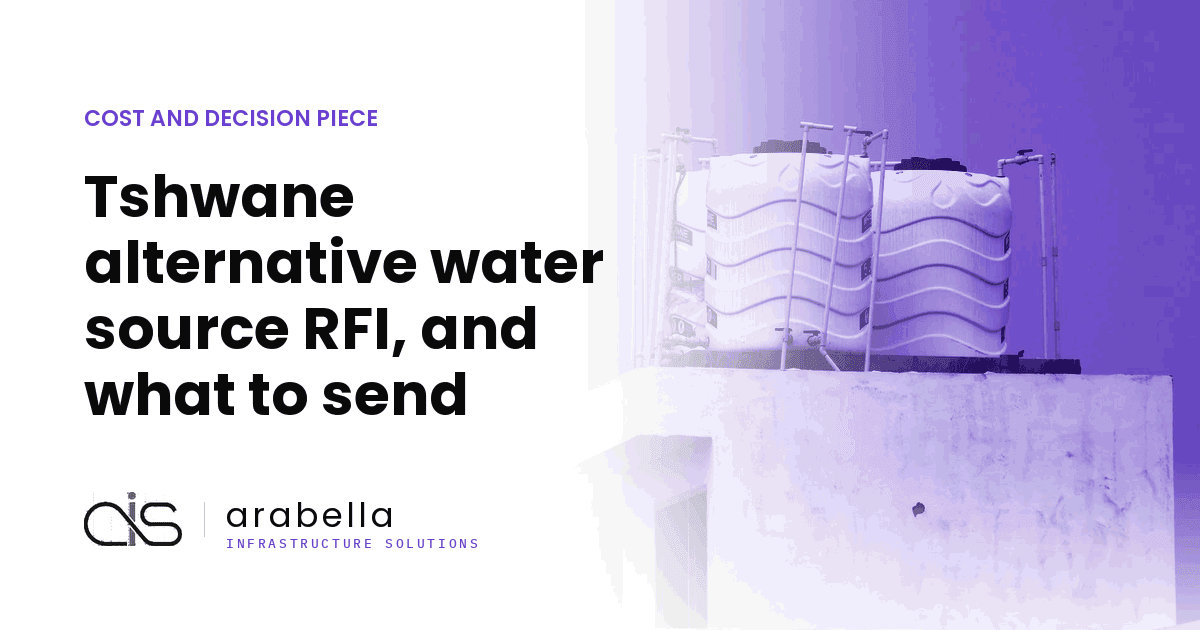
The City of Tshwane's alternative water source RFI, WSBU 03-2026/27, asks reputable entities with experience for possible solutions on alternative sources of potable water. It closes on 30 October 2026 at 10:00, with no briefing session. It buys nothing, but the City says it will use the answers to write the specification for an open tender.
That is the whole case for a supplier's time. An RFI is the stage where a metro asks the market what works before it writes a specification. Once the specification exists, a product either fits it or it does not.
What the Tshwane RFI asks for
The City published the request in Notice 03 of 2026/27 on 11 September 2026, and it is also listed on the national eTenders portal. Its 25-page RFI pack sits on the City's SAP Ariba listing, linked from the notice.
The document invites consulting firms, research institutions and technology providers. Its stated aim is water sources other than the usual treatment works and bulk purchases. It calls water tankers unsustainable, citing high operating costs, logistics and environmental concerns. The areas it lists, without limiting itself to them, are these:
- Rainwater harvesting, for potable and non-potable use.
- Sand abstraction from rivers and underground water.
- Groundwater recharge with treated surface water, stormwater or wastewater.
- Surface water bodies, and artificial ponds that collect runoff.
- Greywater recycling, and wastewater treatment and reuse.
- Emerging technology, such as harvesting water from atmospheric moisture.
- Boreholes, new sites with quality and yields, and equipping existing ones, especially in and around informal settlements.
Respondents are also expected to cover feasibility, the infrastructure and technology options, and implementation plans with cost estimates, timelines and risk assessments. The document says no scoring or evaluation will be done on the responses, and that what is submitted will be treated as strictly confidential.
The practical terms, from the document:
- Who is considered. Only bidders registered on the Central Supplier Database, with a CSD number.
- What goes in. The MBD forms, signed, plus a company registration certificate, rates and taxes or a lease agreement, a SARS tax PIN and a CSD summary report.
- How it goes in. Online through the City's SAP Ariba e-tender portal, which the City is moving its bids onto. The pack also requires one supplementary hard copy, an exact copy of the upload, in the tender box at Tshwane House, 320 Madiba Street, Pretoria, by 10:00 on 30 October. Its MBD 1 form says documents "may be" deposited there. Send the hard copy anyway.
- Who to ask. Technical enquiries go to John Mhlanga, 012 358 7789, johnmh@tshwane.gov.za. Supply chain enquiries go to Lukkie Thobejane-Selowe, 012 358 6282, lukkiet3@tshwane.gov.za.
Its Water and Sanitation Business Unit is buying at the same time. The Ekangala wastewater treatment works upgrade (WSBU 04-2026/27) closes on 28 October, and the Magalies Reservoir refurbishment (WSBU 05-2026/27) on 26 October.
Why would a metro want alternative water now?
Because water is getting more expensive to buy and to lose. Tshwane's 2026/27 water tariff rose 10% from 1 July 2026, according to the City's own tariff notice, and a Cape Town plumbing firm writing in Plumbing Africa reports the same figure. The Department of Water and Sanitation's 2025 No Drop assessment puts national non-revenue water at 47.3%, barely moved from 47.4% in 2023, according to the department's briefing to Parliament on 9 June 2026. Nearly half the treated water in South Africa earns no revenue.
We covered what those increases do to a building owner in municipal tariffs in July 2026. For a metro the arithmetic is the same at a larger scale. Every source that does not depend on bulk supply is a hedge.
Is an RFI worth a supplier's time?
Usually yes. The cost is a few days of a technical person's time. What comes back is a specification written with your product in mind, or at least not written to exclude it.
The risk is the opposite outcome. A competitor answers, and the tender that follows names their pressure rating, their tank material or their treatment method. We set out what a spec line is worth in your spec in a municipal tender.
A supplier of tanks, rainwater harvesting, greywater treatment, borehole equipment or packaged treatment plant fits the document's "technology providers". The scope reads partly like a consultant's study brief, so a product supplier should answer the areas it knows and say plainly which it does not cover.
What to send
An RFI response is not a bid. Write it to help the official who has to draft the next document.
- Follow the scope in section 3, in its order. Do not attach a brochure in place of an answer. The document accepts supporting material only if it is relevant.
- Show it working in South Africa. The City asks for global case studies. Add local installations, with dates, volumes delivered and how long they have run.
- State the standards the product meets and attach the certificates. If a component has a SANS mark, say which.
- Name who installs and maintains it. This is the question most suppliers skip. A metro does not buy a product. It buys water arriving, which needs a contractor on site and a maintenance arrangement afterwards.
- Give a cost per kilolitre over the life of the system if you can support it. That is the number to set against the bulk purchases and tankers the City wants to move away from.
- Say what would make it hard to deliver. The document asks for risk assessments, so name the risks before the City finds them.
Groundwater has its own registration rules, which we covered in the borehole registration deadline. A borehole solution that ignores them will not survive the first read.
Where Arabella fits
Arabella Infrastructure Solutions is a Johannesburg-based building maintenance and construction company that introduces verified contractors to the clients and brands that need them. For a brand answering a metro, that means point four can name installers who have already been checked, rather than promising to find some later. The brands page sets out how that works.
On Monday
Open Notice 03 of 2026/27 on the City's site and download the WSBU 03-2026/27 pack from its Ariba link. Check your CSD registration is current, and register on Tshwane's SAP Ariba portal if you have not. Put 23 October in the diary as your internal deadline, a week ahead of the 30 October close, so the hard copy reaches Tshwane House in time. Then write down three South African sites where your product is running, with the litres each one delivers. If you cannot fill that list, that is the gap to close before you answer.