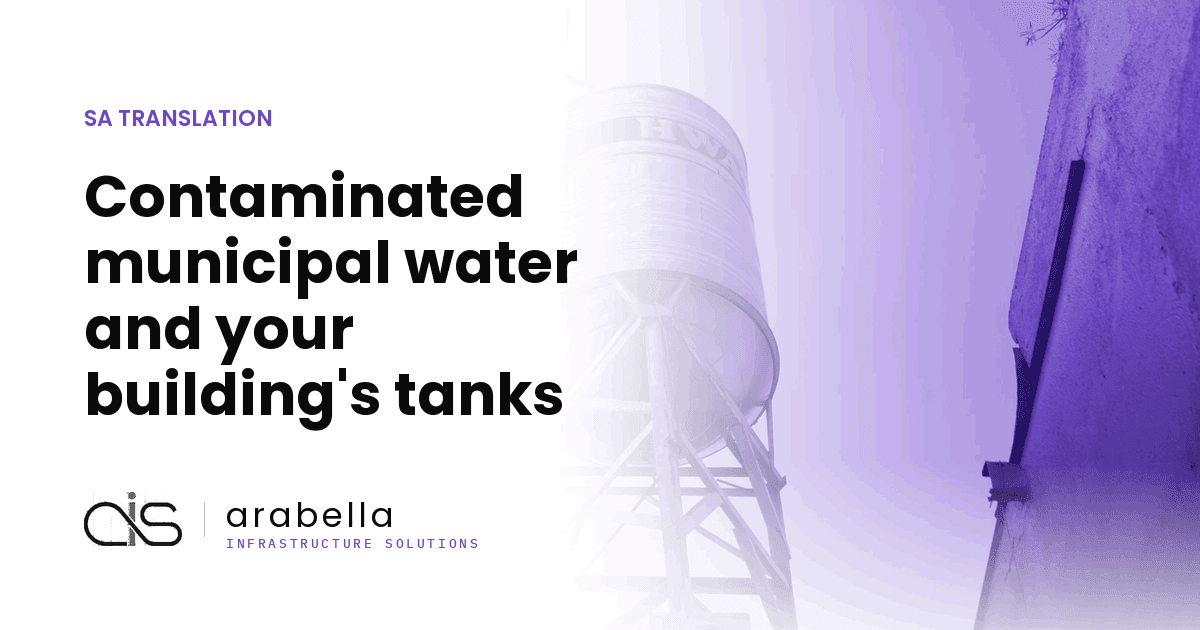
If a building's tanks filled from the Bronkhorstspruit works between 24 September and 14 October, treat what is in them as contaminated municipal water. Officials have told residents to throw stored water out and disinfect containers, and no date has been given for safe tap water.
That instruction was written for households. A school, a factory at Ekandustria or a block of flats holds the same water in bigger tanks. The only word for them so far is one line from the City telling owners of large tanks to ask it for guidance. This piece sets out what officials in South Africa said, what they left out, and the decisions an owner or managing agent faces this week.
What happened at the Bronkhorstspruit works?
The City of Tshwane had difficulties with its chlorine supply, so unchlorinated water left the Bronkhorstspruit Water Treatment Works from 24 September to 14 October 2026. Water and Sanitation Minister Pemmy Majodina gave that finding at a media briefing on Monday 19 October, reported by Plumbing Africa and TimesLIVE. She said the City "failed to warn residents in the affected areas".
Tests by the Department of Water and Sanitation (DWS) on 14 October found very high levels of E. coli and total coliforms. They were in the water leaving the works and in the Ekandustria and Zithobeni reservoirs. The City closed the works on 14 October, restored chlorine by 15 October and reopened on 16 October. It told residents the water was not yet suitable for drinking.
On Monday 26 October the minister said cases had risen from 408 to 833, SAnews reported. "No critical cases or deaths have been reported so far." Bizcommunity's report the same day still gives the older count of more than 400, and says the Public Protector is investigating.
One detail matters to anyone holding storage. Even after the plant was shut down and tankers were deployed, she said, "some residents continued using water they had stored in containers".
What did officials tell residents to do?
The minister named Bronkhorstspruit, Zithobeni, Dark City, Rethabiseng and Sokhulumi, in Tshwane's Region 7. The City's own advisory of 20 October, carried by SAnews, also lists Ekandustria and Ekangala, and communities in Thembisile Hani Local Municipality supplied across the border from the same system. Residents were told not to drink, cook, bathe, brush teeth or wash clothes with tap water. "The water can only be used for flushing toilets," the minister said, per SAnews.
On storage, the minister's instruction was short. "Previously stored water should be discarded and water containers must be disinfected using household bleach". The City's advisory says the same in more detail: discard stored tap water, and clean containers with soap and water, then domestic bleach, before refilling with tanker water. Drinking water from tankers should be kept in clean containers with lids. The City's advisory adds that boiling does not make the water safe.
The City added one line for bigger storage: "Those with large storage tanks should obtain cleaning and disinfection guidance from the city." No such guidance has been published. Nothing official mentions booster sets or a building's internal pipes, and the City says restrictions lift only once testing confirms the water meets the required standards, with no date given.
Our reading for a building with its own storage
A building tank is a container on a larger scale. If it filled during those three weeks, the logic of the instruction applies to it, and in our reading the water should be used for flushing only. That is our extrapolation; no official guidance covers building tanks.
A tank is not a bucket, though, and a bottle of household bleach is not a method for a tank on a roof. Draining, cleaning and disinfecting a building's storage, and flushing the pipes it feeds, is plumbing work. The City has told large-tank owners to ask it for guidance but has published no method, so ask the City in writing and do not invent one.
Ask a registered plumber to set out the method in writing before starting. Ask for a record of what was done, on which tanks and on what date. A plumbing certificate of compliance is about the installation, so do not assume it covers disinfection. Ask the plumber what document you will get.
Timing is the other decision. Cleaning a tank and refilling it from a supply still under a do-not-drink advisory gives you a clean tank of unsafe water. Whether to drain now and leave the tank empty, or hold it isolated until the supply is cleared, is a question for your plumber and the City.
Who pays, and who approves the spend?
In a sectional title scheme the trustees approve the spend, and who approves the quote decides how fast the work starts. Where the work cannot wait, the rules for emergency repairs in a body corporate apply.
Whether the City pays is not settled. DWS said it has started "necessary accountability steps" against those responsible. Keep every invoice and the plumber's record together, because a claim later needs both.
What to ask Tshwane before you refill
According to the figures reported by Plumbing Africa, the City has spent about R21 million this financial year on the works, with more than R107 million in expenditure and planned investment over three years. The City appointed Rand Water to rehabilitate the works, and at the 26 October briefing the minister said government had instructed Rand Water to begin with Phase 1 of the plant, according to SAnews. Deputy President Paul Mashatile spoke at the same briefing. "We cannot give a specific timeframe, but work has already begun."
Plumbing Africa reported that an independent report from the Water Research Commission was due by 28 October. We have not found it published, and it is now more than a week overdue. Rand Water began flushing and disinfection (its phase two) on 28 October, and the City suspended tanker filling at the Cullinan hydrant on 27 October after elevated turbidity. As of the Mayor's statement reported on 3 November, the water was still being disinfected and residents were urged not to use it.
Before you refill, ask the City these questions in writing:
- Has the advisory been lifted for our address, and on what date?
- What is the City's cleaning and disinfection guidance for large storage tanks?
- Which reservoir feeds our connection? Ekandustria and Zithobeni both tested contaminated.
- Has the Water Research Commission's report been released, and what did it find?
- Who has tested the water at our connection since the works reopened, and can we see the result?
On Monday
List every tank on the property, its capacity and whether it filled between 24 September and 14 October. Put a flushing-only notice on every tap those tanks feed. Then book a registered plumber and ask for the method in writing before they start.
Arabella Infrastructure Solutions is a Johannesburg-based building maintenance and construction company, open 24 hours a day, 365 days a year, that checks plumbers against the registers before sending them to a building. For a managing agent or a school, that is one call for tank work by a plumber whose registration has already been checked, and the paperwork to show for it. How that works is on the client page.